Compressed Air Tank Supply in Houston, Texas
Clean, dry compressed air supply for manufacturing, medical, scientific, fire protection, and industrial applications.
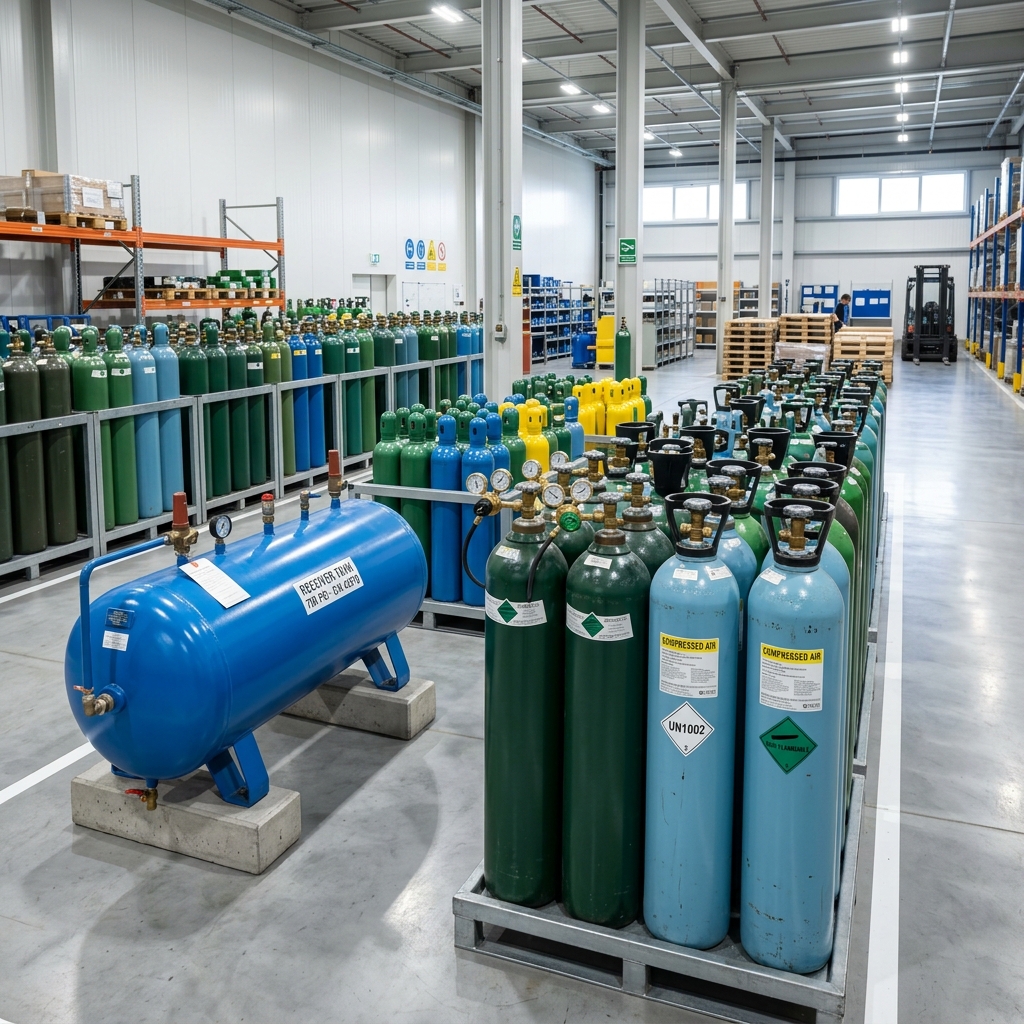
Compressed Air Tanks & Cylinder Supply
Havard Welding provides compressed air supply solutions for manufacturers, healthcare facilities, laboratories, fire protection services, and industrial operations throughout East Houston. From a single compressed air tank to bulk cylinder needs, we help businesses source the right air supply for their operating requirements.
About Air Composition and Properties
Air is the Earth's natural atmosphere and consists primarily of nitrogen and oxygen, along with small amounts of argon, carbon dioxide, water vapor, and trace gases. It is colorless, odorless, non-flammable, and is one of the most widely used industrial gases in manufacturing, healthcare, research, and commercial operations.
For applications requiring controlled purity, compressed air is produced by combining purified oxygen and nitrogen to create a consistent mixture containing between 19.5 and 23.5 percent oxygen, with nitrogen making up the balance. This process removes many naturally occurring atmospheric components, resulting in clean, dry air suitable for specialized industrial use.
Purification and Separation Processes
To ensure air quality for sensitive applications, compressed air is processed carefully to minimize moisture and contaminants, making it non-corrosive. Liquefied air appears transparent with a slight bluish tint and may develop a milky appearance when carbon dioxide is present.
Since air is a mixture, its individual gases can be separated through cryogenic air separation. This involves cooling air to approximately -320°F (-195.6°C) until it liquefies, followed by fractional distillation to isolate nitrogen, oxygen, argon, and other atmospheric gases for specific industrial applications.
While many facilities generate compressed air on-site, certain industries require certified air that meets strict purity standards. In such cases, the air is purified or blended to meet application requirements before being packaged in high-pressure cylinders for transport and use.
Typical Composition of Dry Air
The composition of dry atmospheric air remains remarkably consistent at sea level and at elevations up to approximately 70,000 feet, with only minor variations caused by geography, industrial activity, humidity, and environmental conditions.
| Component | % by Mole | % by weight |
|---|---|---|
| Nitrogen | 78.084 | 75.5 |
| Oxygen | 20.946 | 23.2 |
| Argon | 0.934 | 1.33 |
| Carbon Dioxide | 0.0335 | 0.045 |
| Neon | 0.001818 | - |
| Helium | 0.000524 | - |
| Methane | 0.0002 | - |
| Krypton | 0.000114 | - |
| Nitrous Oxide | 0.00005 | - |
| Xenon | 0.0000087 | - |
Safety & Chemical Specifications
DOT Information
| Property | Specification |
|---|---|
| DOT Name | Air, compressed |
| DOT Hazard Class | Nonflammable Gas (2.2) |
| DOT Label | Nonflammable Gas |
| DOT ID No. | UN 1002 |
| CAS No. | None. (for nitrogen, 7727-37-9; for oxygen 7782-44-7) |
| Valve Outlet | CGA 346, CGA 950 pin-indexed |
| Physical State in High-Pressure Cylinder | Gas |
| Toxicity | Nontoxic |
| Fire Potential | Non-flammable |
Physical Properties of Air
| Property | Value |
|---|---|
| Chemical Name | Air |
| Molecular Weight | 28.975 lb/mol |
| Specific Volume at 70°F and 1 atm | 13.346 ft³/lb (0.8333 m³/kg) |
| Specific Heat | 6.96 BTU/lbmol-deg F @ 70 deg. F |
| Specific Gravity | 1.000 |
| Gas Density | 0.07992 lb/ft³ @ 70 deg. F. 14.7 PSIA |
Boiling Point
| Temperature: | -317.7 deg. F (-194.3 deg. C) |
| Liquid Density: | 54.60 lb./ft³ |
| Latent Heat: | 87.9 BTU/lb. |
Critical Point
| Temperature: | n/a |
| Pressure: | n/a |
Melting Point
| Temperature: | n/a |
| Pressure: | n/a |
Industrial Cylinders
| PART NUMBER | CYLINDER SIZE | WEIGHT OF GAS (LBS.) | PRESSURE (PSI @ 70F) | DIMENSIONS (Height x Diameter) | CAPACITY (Gallons) | CAPACITY (Liters) |
|---|---|---|---|---|---|---|
| CABE | 22 ft³ | 1.75 | 2015 | 30" x 4.25" | 161 | 622 |
| CAB231 | 231 ft³ | 17.28 | 2217 | 51" x 9" | 1727 | 6534 |
| CAB297 | 297 ft³ | 22.21 | 2492 | 55" x 9.25" | 2221 | 8401 |
Various Applications of Compressed Air
Compressed air plays an essential role across numerous industries by providing a clean, dependable source of power and breathable air for specialized equipment and controlled environments.
Manufacturing & Pneumatic
A compressed air system by Havard Welding powers pneumatic tools, manufacturing equipment, and automation systems, ensuring consistent air pressure for daily operations.
Medical & Healthcare
Medical-grade compressed air is supplied for respiratory equipment, patient care systems, and healthcare environments where air purity must meet established standards.
Fire & Emergency
Compressed air cylinders are used in self-contained breathing apparatus (SCBA) worn by firefighters, emergency responders, and industrial safety personnel working in hazardous environments.
Scientific & Laboratory
Research laboratories use purified compressed air for analytical instruments, testing equipment, and experimental procedures that require controlled gas composition.
Aerospace & Undersea
Specially prepared compressed air supports aerospace testing, diving operations, and other applications that require carefully controlled breathing gas mixtures.
Industrial Processes
A well-maintained compressed air supply system supports manufacturing, packaging, instrumentation, and production processes where clean, dry air enhances equipment performance and operational efficiency.
The Importance of Clean Compressed Air
The quality of compressed air can directly influence equipment performance, product quality, and workplace safety. Moisture, oil, and airborne contaminants may reduce system efficiency, damage pneumatic equipment, and interfere with sensitive manufacturing processes.
Purified compressed air minimizes these concerns by delivering a controlled gas composition suitable for demanding industrial, medical, and scientific applications. Selecting the appropriate compressed air system or compressed air tank depends on the required pressure, purity level, storage capacity, and intended application.